


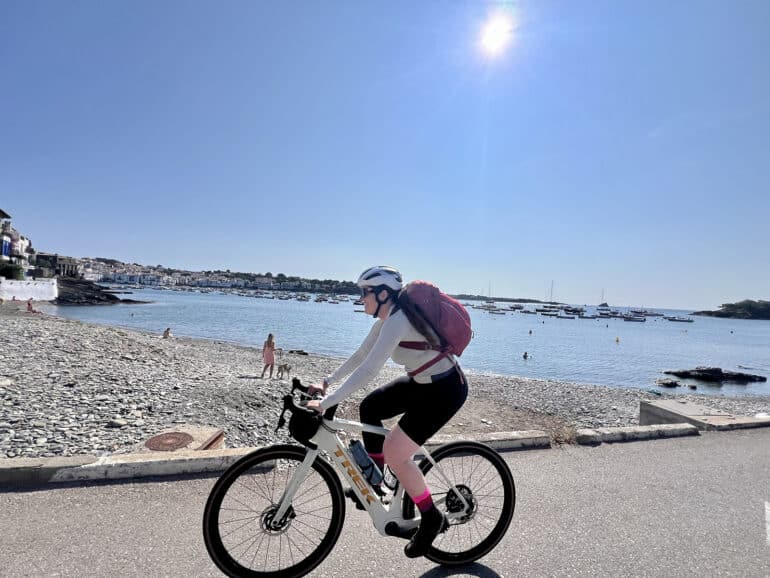

If I didn’t know better, I would’ve thought I was on a stunningly beautiful, remote Greek island. White stucco buildings clung to the craggy hillside, precipitously dropping into an azure sea, but there I was pedaling into the postcard perfect coastal village of Cadaqués with my wife Vanessa, our bikes loaded with just enough gear to get us through a five-day credit card bikepacking journey along the Costa Brava of Spain. Translated as the “wild or rough” coast, the Costa Brava lies in the Catalonia region, to the northeast of Barcelona. Its history dates to the 1st century B.C., which means it has a network of paved roads, bike paths and gravel that make it an ideal location to explore on two wheels.
Cadaqués, where Salvador Dali lived and worked from 1930 to 1982, was our first stop. The town’s bleached white buildings glowed in the midday sun as we pedaled into the bustling town center. The villagers’ character has been forged by piracy, contraband, isolation, bad luck—and the tramuntana, the maddening north wind that pummels this part of the Costa Brava which, thankfully, was not present during our two-day stay at the Hotel Llané Petit. Regarding piracy, Miguel de Cervantes, author of “Don Quixote de la Mancha,” was kidnapped by Ottoman pirates near Cadaqués and held prisoner in Algiers for five years before a monastic order raised his ransom.
But before I continue this seaman’s tale, let’s step back to how our journey began. We landed in Barcelona and walked more in 24 hours than I have in the past six months, before taking a train to Girona, where we enjoyed the comforts of the Hotel Casa Cacao. The next morning, after a great culinary breakfast experience, we loaded our bikes and pedaled a few minutes to catch the train to the fishing village of Llançá, where our five-day adventure began with, of course, a coffee, snack and beer at one of the cafés on the harbor front. Properly fueled, we pedaled out of town, tracing the edges of the craggy coastline, smiles plastered across our faces because of the overwhelming beauty. Before making it to Cadaqués, we took a detour into the quiet fishing and wind sports hamlet of El Port de la Selva, because it looked cool, and pedaled past lightly populated harbor café/restaurants, the summer tourist season not yet in full swing.
No one had their face buried in a phone, no one was distracted from the present moment, emphasizing the priority that Spanish culture places on human interactions.
After two days of beach lounging, town walking, healthy eating and overall good living, the 5 kilometer climb out of Cadaqués was a shock to the legs, but a refreshing reminder of the fun and freedom that comes from packing up your bike and pedaling into unknown terrain. On a trip like this, the only limitations are your sense of adventure and the setting sun. Your pedal strokes dictate the pace of the day, so when the only clock ticking is nightfall, it opens up opportunities for mid-ride coffees at local cafés, unplanned seaside stops for paella, and route detours to hidden beach spots. Sometimes, not having a clear plan is the best one, and not being tied to a schedule, or arrival deadline, allows you to pick and choose your adventure as each day presents itself.
After a few wrong turns on the outskirts of Roses, our day concluded with a patchwork quilt of rice fields, vineyards, side roads and coastal bike paths that meandered through low-lying farmland to our day’s final destination, the Hostal Empúries, a stunning coastal hotel on its own private beach in L’Escala. The hotel was built in 1907 to house the first archaeologists who undertook the excavations and recovery of the Graeco-Roman site of Empúries, whose ruins have long been a tourist attraction.
YURI’S FULL STORY ONLY IN THE FAUSTINO NEWSPAPER


