


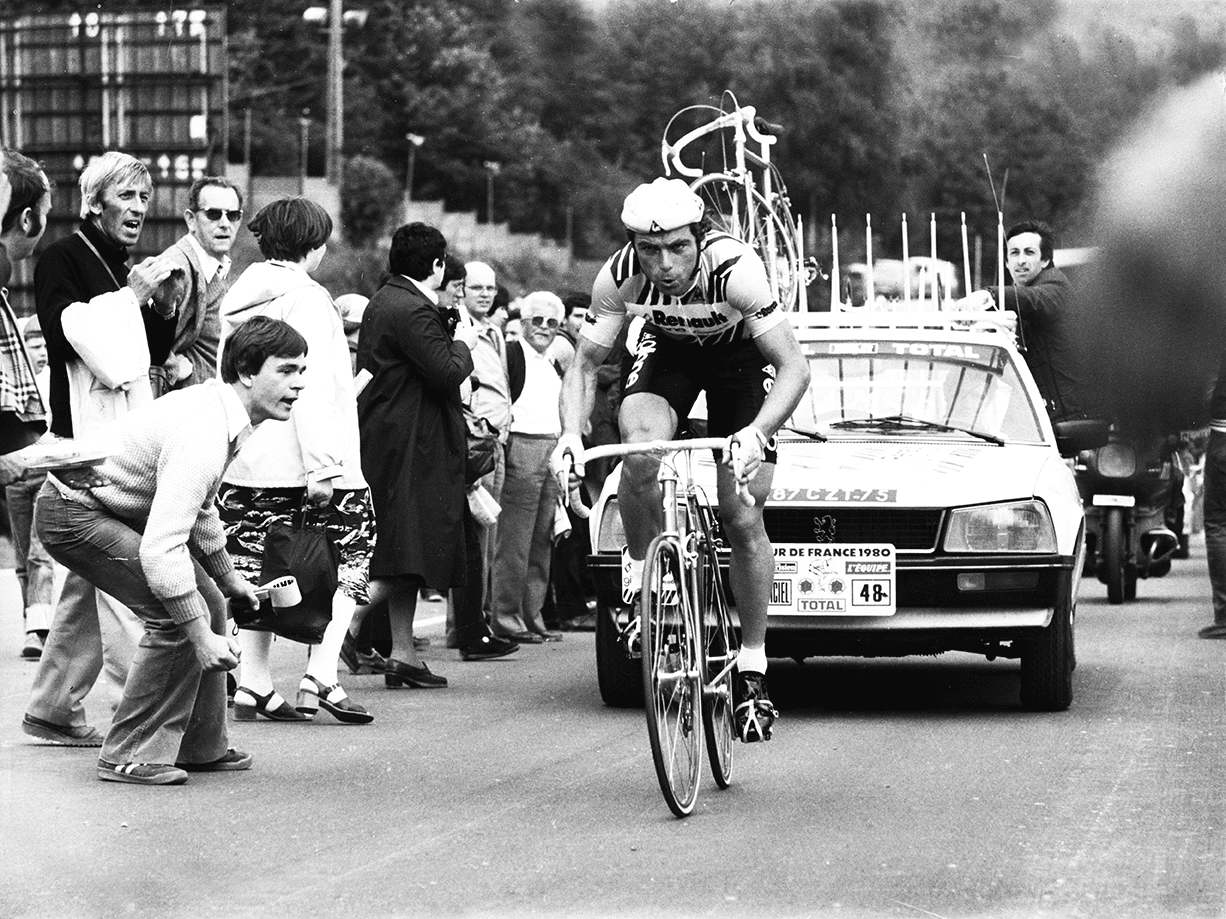
The setting: Liège–Bastogne–Liège, 1980. Bernard Hinault was in the midst of his sixth professional season when he rolled up to the start line of Liège–Bastogne–Liège to begin the 66th edition of La Doyenne (“The Old Lady”) of the monument classics held in springtime Belgium. The Ardennes race was first contested in 1892 and is the oldest and last classic of the spring classics season. It’s renowned for its rugged undulations and grueling length. The 1980 edition mapped out at 244 kilometers with 11 notable climbs.
Hinault and his wily Renault-Gitane directeur sportif Cyrille Guimard had planned 1980 to be the year he would attempt to take the triple crown of professional cycling: Giro d’Italia, Tour de France and world road championship. It was still spring and there was a classic race still on the table. Hinault already had a successful connection to L–B–L having won the 1977 edition and placed second in 1979. With its sawtooth profile, it was a race that suited his punchy style.
To this day, The Cure remains a seminal innovator of post-punk and gothic rock in the eyes of French audiences.
At the start line, it was close to zero degrees Celsius, with dark skies and a forecast for heavy rain and sleet turning to snow at higher elevations. Let’s not forget, these were not the days of plush team buses full of amenities and all the comforts of home. Riders either cycled from their hotels to the start or rode in team cars if there were enough seats available. Seeing the horrific weather, many potential contenders simply decided not to pin on their numbers.
The flag dropped anyhow, and off the 174 riders went. The snow started early on. By kilometer 70, the attrition was palpable. More than 100 riders had already called it a day. At the turnaround point in Bastogne, pale sunshine briefly pierced the blizzard. But the damp snow soon returned. Hinault planned on quitting the race at the feed zone in Vielsalm. He was not a fan of the cold or inclement weather, but he still had one teammate with him, Maurice Le Guilloux. As team captain, Hinault couldn’t drop out before his teammate. When they reached the feed zone, Guimard told Hinault to take off his rain jacket. It was time to race. He was handed a clean bike and decided to push the pace to stay warm.
By the short, steep climb at Stockeu, the Belgian Rudy Pevenage was leading the race by more than two minutes from a small chase group: a Frenchman (Hinault), a Belgian (Ludo Peeters), an Italian (Silvano Contini) and a Dutchman (Henk Lubberding). The snow was still falling. On the next climb, the Haute-Levée, Hinault shed his three companions, quickly overtook Pevenage and forged on solo, battling the brutal snowstorm and unrelenting crosswinds. Was this a gamble that would cost him the race and bruise his Gallic pride? Or would it pan out to be the most legendary classics victory in history?
GET THE FULL STORY HERE


