


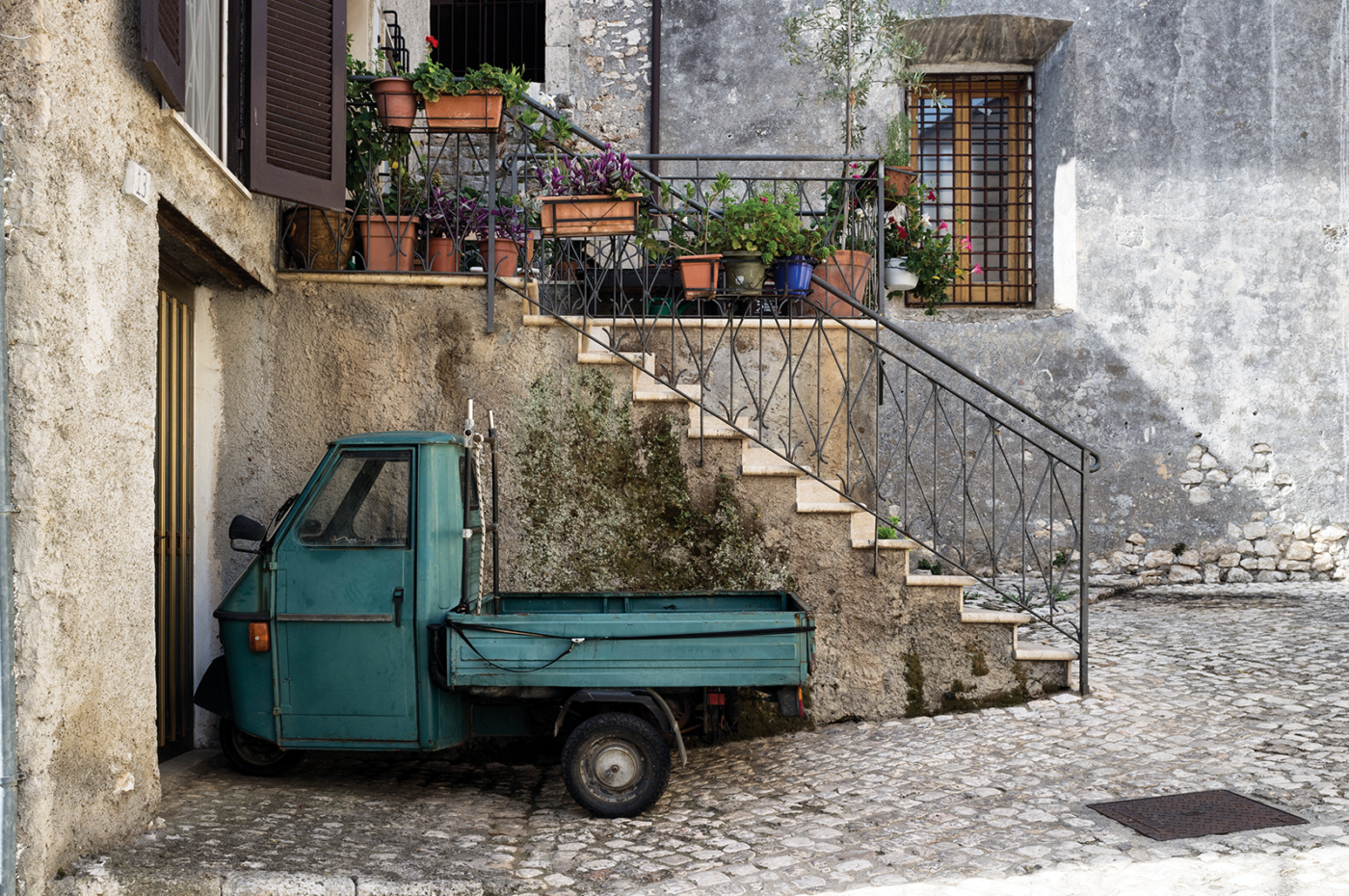


When climbing hills in the Monti Lepini of central Italy, your fatigue becomes part of the landscape: There’s no rush, only the time needed to listen to the sound of your tires on the asphalt and inhale the scent of soil beneath a blanket of olive trees. The Lepini mountain chain sits in Lazio, stretching across the provinces of Latina, Rome and Frosinone. Its highest peak is Monte Semprevisa, at 1,536 meters (5,039 feet). Locals call it Cima Nardi, in honor of the late mountain climber Daniele Nardi, who used to train here. From the summit on a clear day, you can see as far as the Pontine Islands, 40 kilometers off the coast. In the mountain’s shadow sit more than a dozen hill towns, three of which—Sermoneta, Norma and Bassiano—have welcomed the quiet part of my soul since I was young, refuges far from the cacophony of Rome.
SERMONETA
The climb to Sermoneta is short, about 4 kilometers with an average grade under 5 percent with 185 meters (just over 600 feet) of elevation gain. Still, it’s one of those ascents that force you to find a good rhythm. As your breath grows shallower, warm air mixes with the scent of olive trees and stone. The village appears all at once, dominated by Castello Caetani, a well-preserved 13th century fortress that rests above the valley with a solid calm. Entering the town is like crossing a threshold in time: open doors, elderly folks in the square, children playing without fear. Life moves slowly here, suspended in medieval serenity.
I could listen to Lucia for days, lulled by her affectionate donkeys. Here, the landscape of the Lepini transforms into flavor, story, shared memory.
Sermoneta welcomes you without hurry, and when you get back on your bike, it feels like you’re taking a piece of its silence with you. Just below the town, the Abbey of Valvisciolo guards a rare kind of silence. The home of Cistercian monks, this ancient stone building hides the shade of arches, the still air of the cloister, where everything speaks of balance. I stop here on every trip, even if only for a moment, just to step off the bike and leave behind a thought I don’t need. Then I climb back on, slowly. The road begins to rise again, this time toward Norma.
NORMA
The climb to Norma is about 5 kilometers, with 300 meters (almost 1,000 feet) of elevation gain and an average gradient of 6 percent. It’s an exposed ribbon of road with very little shade. Every meter gained reveals another piece of the landscape, until the Pontine plain opens up below—a green sea stretching toward the horizon. From above, you can admire the Gardens of Ninfa that include the ruins of a medieval town, a natural monument of the Italian Republic.
GET THE FULL STORY IN PRINT


