

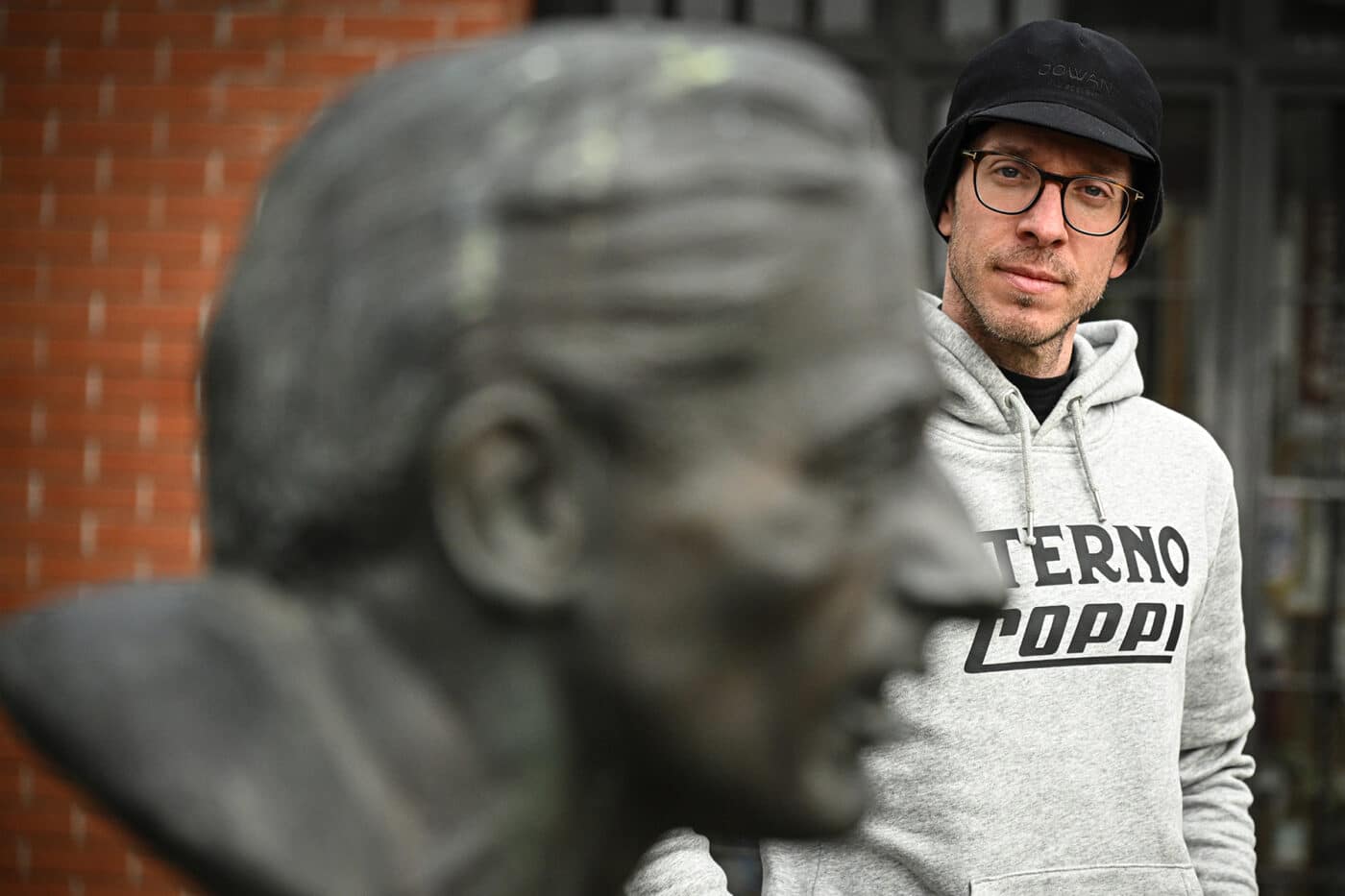

I met FREDERIK BACKELANDT this summer at a Bianchi event in Treviglio, Italy. He was the first person I walked up to; I was holding the premiere issue of Fausto. We instantly hit it off and started talking about magazines (he is the publisher of Grinta in Belgium), print publishing and Coppi. As we looked at all the new Bianchi bikes adjacent to the historical museum in the Bianchi offices, there were Coppi memories everywhere. We moved onto dinner where we continued to talk; and the more I learned about Frederik, the more I wanted to know. We had a chance to catch up a few months later and talk about his sincere passion for the history and story of Fausto Coppi.
How did this passion for Fausto Coppi begin for you? Well, there was a TV series made by Rai, the Italian TV network, called “Il Grande Fausto”— it was broadcast in 1999 on Belgian television. It was the life of Fausto Coppi in two parts. I saw it and I was very struck by the story, of course. I was a young guy, you know, I was born in 1982, so you can count out how old I was (17). So, I was still in high school, and I was really fixated and very astonished by the story of Fausto Coppi and the tragedy in it, the glory in it, all the elements. You know them well: his early death and his presence everywhere, his image, the stories of his cheating on his wife. Of course, there was also the beautiful Italian actress, Ornella Muti, who is a stylish icon in Italian cinema. All the elements of the story struck me and that started my fascination for Fausto Coppi.
What about the story moved you? I was already very into history as a student, and I started to study history at the University of Ghent. The year after I saw the movie, I went with my parents to the regions of Piedmont and Liguria, and we visited some spots at the coast where there are monuments to Milan–San Remo and monuments to Coppi. We also went to his birth village and to the museum—and there it all started.
It’s all the other elements as well and the fact that he invented the modern sport. Let’s say the discipline, the team discipline, the training, nutrition— he started all those things.
Were you riding bikes yourself at this point? I had just started in 1997, ’98, inspired by the great Belgian rider, Frank Vandenbroucke, the talent that was wasted of course afterwards. But, wow, what a guy! He predicted where he would attack, and he attacked there and did it! I was also inspired by Jan Ulrich in the Tour de France, the young guy who wasted all his talent in some way. I was intrigued by those guys, and I started to do cycling myself. I then joined a club and went to some smaller races. I did some freelance work back then for cycling magazines and it all started. I think the stories always intrigued me. At the end of my four-year period of studying, I had to do a thesis.
That project was also inspired by cycling. My thesis focused on the connection between nationalism and nationalist feelings during the period between the two world wars. Because then, of course, a lot of nationalism came up in Flanders. So, the founding father of the Tour of Flanders was a Flemish nationalist. He tried to express his nationalism and lift up his people, the poor Flemish people, by talking and telling stories about the great Flandriens. So, like the big, tough guy who wins races and is very strong, and all the weather challenges, he overcomes everything. So that was the focus of my research. And there it kicked all in, you know, everything started there, because I won a prize with that paper, an important prize of the best paper of all universities. From that moment, I started at a newspaper and became a cycling journalist.
MORE ABOUT BACKELANDT IN THE FAUSTINO NEWSPAPER


